Uncategorized

Medical devices housed in plastic enclosures face a persistent engineering challenge. Plastics offer design freedom and weight savings, but they provide zero inherent electromagnetic shielding. Every unshielded plastic housing is transparent to electromagnetic energy, allowing interference to flow in both directions. For product development teams working under IEC 60601-1-2 compliance requirements, selecting the right shielding process can determine whether a device passes or fails EMC certification.
Two conductive coating methods dominate the conversation: vacuum metallizing and conductive paint. Each deposits a conductive layer onto a nonconductive substrate, but the mechanisms and manufacturing tradeoffs differ substantially. Plastic-Metals Technologies applies vacuum metallized coatings to medical device enclosures using Physical Vapor Deposition (PVD), a chemical-free process that creates dense, uniform shielding layers.
This article compares vacuum metallizing and conductive paint for medical device EMI shielding, focusing on complex plastic geometries where coating uniformity and reliability matter most.
Vacuum metallizing, also referred to as physical vapor deposition (PVD), vaporizes metal inside a vacuum chamber and condenses it as a thin, continuous conductive film onto the surface of a substrate. For medical device applications, this process typically deposits copper as a base layer, followed by a protective overcoat of nickel or aluminum. The result is a shielding layer typically 1 to 3 microns thick.
Because the metal arrives at the substrate surface as individual atoms or small molecular clusters, the resulting film conforms tightly to the part geometry. This atomic-level deposition produces a dense, continuous conductive barrier that maintains uniform thickness even across ribs, bosses, and recessed features common in injection-molded plastic housings.
The process uses no chemicals and produces no volatile organic compounds (VOCs). For medical device manufacturers navigating RoHS and REACH compliance, this chemical-free approach simplifies environmental documentation.
Conductive paint consists of metallic particles, typically nickel, copper, or silver, suspended in a liquid binder. When sprayed onto a plastic enclosure, the binder cures and the metallic particles form a conductive network that attenuates electromagnetic energy. Shielding effectiveness depends on the particle loading, paint formulation, film thickness, and how uniformly the coating is applied.
Application methods include manual spray, automated spray, and brush-on techniques. The wet-film nature of the process allows it to coat large parts that may exceed vacuum chamber dimensions. Conductive paint does not require the capital equipment investment associated with vacuum deposition systems.
One consideration with conductive paint is thickness variability. Spray application can produce inconsistent coverage on complex geometries, particularly in deep recesses, sharp corners, and areas shadowed by ribs or internal features. Thicker areas may interfere with part fit, while thinner areas may reduce shielding performance.
Medical device enclosures are rarely simple flat-panel boxes. Injection-molded plastic housings incorporate snap fits, internal ribs, bosses for hardware insertion, and recessed compartments for circuit boards. These geometric features create challenges for any conductive coating process.
Uniform coverage is the core requirement. Gaps or thin spots in a conductive layer create apertures through which electromagnetic energy can pass, degrading the shielding effectiveness of the entire enclosure. For medical devices operating in electromagnetically dense hospital environments, even small coverage gaps can cause EMC test failures.
Vacuum metallizing addresses complex geometry through its line-of-sight deposition mechanism combined with chamber rotation and precision masking. Parts are fixtured and rotated within the vacuum chamber to expose all interior surfaces to the metal vapor. Conductive paint relies on operator technique or spray automation to reach recessed areas, which introduces more process variability.
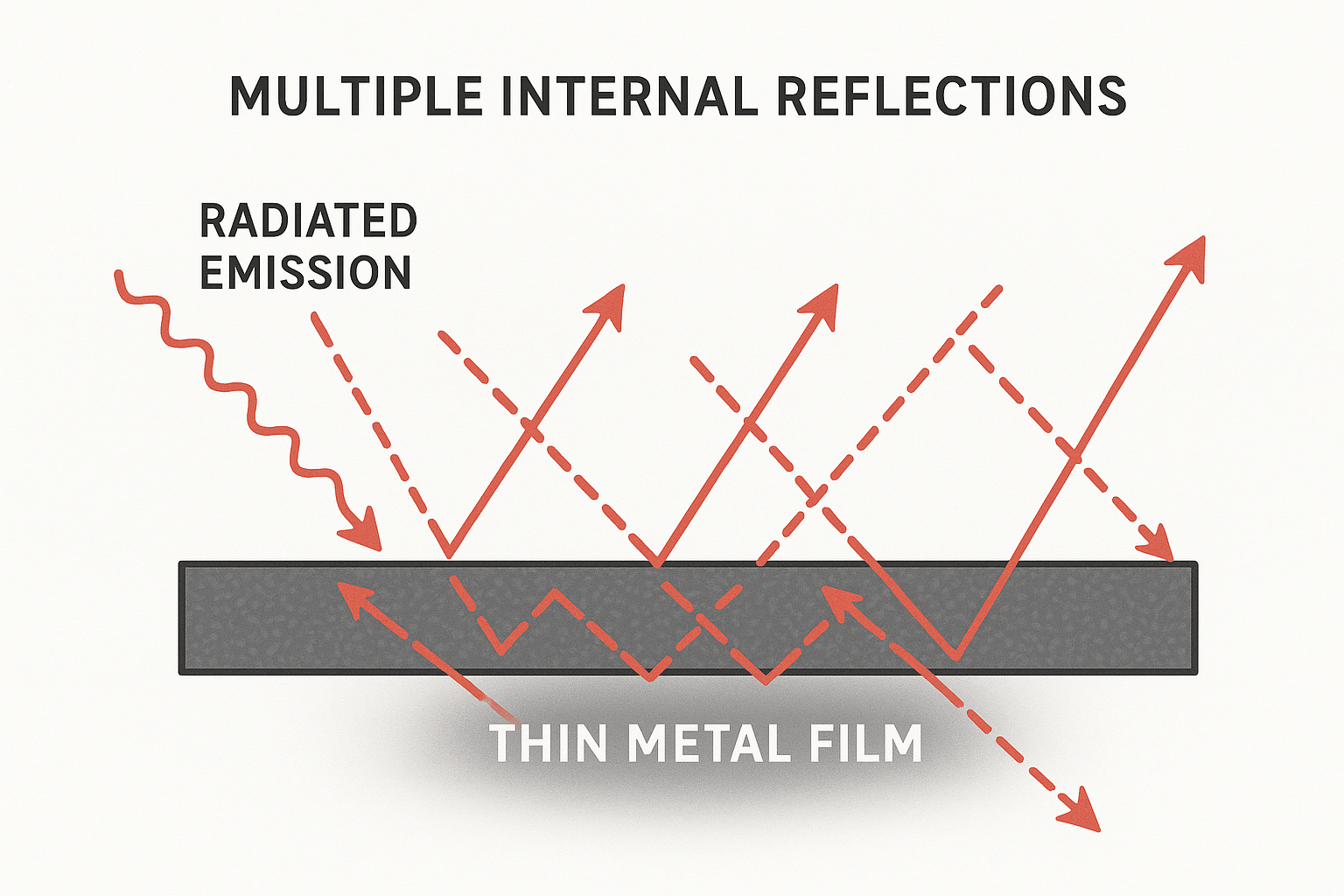
Shielding effectiveness (SE) measures how well a conductive barrier attenuates electromagnetic energy, expressed in decibels (dB). Both vacuum metallizing and conductive paint can achieve SE values sufficient for most medical device requirements, but the mechanisms differ.
Vacuum metallized films achieve their shielding through a dense, continuous metallic layer with high electrical conductivity. The dual-layer approach used by Plastic-Metals Technologies pairs copper (high conductivity for signal reflection) with a nickel or aluminum overcoat (corrosion protection and enhanced absorption). This combination provides EMI/RFI attenuation across a broad frequency range.
Conductive paint achieves shielding through a network of metallic particles within a cured binder matrix. The particle-to-particle contact creates conductive pathways, but these pathways are inherently less continuous than a solid deposited metal film. Shielding performance in conductive paint correlates with particle density, coating thickness, and the quality of inter-particle contact.
Medical devices often undergo sterilization cycles, temperature fluctuations, and extended operational lifetimes. A vacuum metallized film bonds directly to the substrate at the molecular level, and the dense metallic structure resists degradation from thermal cycling. The nickel overcoat in a copper-nickel system protects the copper layer from oxidation, maintaining conductivity over time.
Conductive paint films contain organic binder material between the metallic particles. Over time, environmental exposure, including humidity, temperature extremes, and chemical contact during sterilization, can degrade the binder. This degradation may reduce the mechanical integrity and conductivity of the coating, particularly at elevated temperatures or in high-humidity environments.
Medical devices sold in most global markets must demonstrate electromagnetic compatibility under IEC 60601-1-2, the collateral standard within the IEC 60601 series. This standard requires manufacturers to prove that their devices neither emit harmful electromagnetic energy nor are susceptible to external interference. The FDA enforces EMC requirements through its Center for Devices and Radiological Health (CDRH).
From a shielding perspective, process repeatability directly affects regulatory compliance. A coating process that delivers consistent thickness and conductivity across every production part simplifies EMC testing and reduces the risk of field failures. Vacuum metallizing, controlled by deposition parameters such as vacuum pressure, substrate temperature, and deposition time, produces measurable and repeatable coating characteristics verified by deposition controllers.
Conductive paint performance depends on spray parameters, operator technique, and environmental conditions during application and curing. These variables introduce wider process tolerances that require more extensive quality control to verify shielding consistency.
Vacuum metallizing is well suited for medical device enclosures that require consistent, repeatable shielding on complex geometries. Parts that fit within a vacuum chamber and have intricate internal features benefit from the uniform coverage that PVD provides. Typical applications include diagnostic imaging enclosures, patient monitoring device housings, and surgical instrument casings.
The process is also advantageous when environmental durability is a priority. Medical devices that undergo autoclaving, chemical sterilization, or prolonged exposure to high-humidity environments benefit from the corrosion-resistant properties of a nickel-over-copper or aluminum-over-copper metallized film. Plastic-Metals Technologies provides integrated shielding and secondary services including form-in-place gasketing and hardware insertion, reducing supplier coordination for OEMs.
For product teams seeking a single-source provider, this integrated approach addresses both the shielding layer and the seam-sealing gaskets that complete the electromagnetic enclosure.
Conductive paint may be appropriate for medical device parts that exceed vacuum chamber dimensions or for low-volume prototyping where capital equipment investment is not justified. Large enclosures or flat panels with simple geometries can be coated effectively using automated spray systems.
Paint-based shielding also serves as an option when parts require only moderate attenuation levels and will not be exposed to aggressive sterilization protocols. For early-stage product development, conductive paint provides a way to evaluate shielding concepts before committing to a production-scale process.
It is worth noting that lifecycle costs for conductive paint can increase over time. Thicker coatings consume more material, and the process may require primer coats, multiple spray passes, and extended curing times. These additional steps add labor and processing time compared to the single-cycle vacuum deposition process.
Plastic-Metals Technologies uses a proprietary dual-layer vacuum metallizing process to deposit copper, nickel, and aluminum onto plastic, carbon fiber, and glass substrates. The company's process applies Physical Vapor Deposition to create a 1-micron dense conductive shield without chemicals. Every coated part is tested for adhesion and conductivity before shipment.
The company holds ISO 9001:2015 certification for thin-film metallization services and maintains UL-approved processes on over 35 plastic types. For medical device OEMs, these certifications reduce the qualification burden when integrating vacuum metallized shielding into regulated products.
Beyond metallizing, Plastic-Metals Technologies offers secondary operations including form-in-place gasketing, hardware inserting, pad printing, and electrical testing. This single-source model allows medical device manufacturers to consolidate shielding, assembly, and verification with one provider, reducing lead times and coordination complexity.
The choice between vacuum metallizing and conductive paint depends on part geometry, production volume, required attenuation, environmental exposure, and long-term reliability expectations. For complex plastic medical device enclosures that must meet IEC 60601-1-2 compliance under demanding hospital conditions, vacuum metallizing offers the consistency, durability, and process control that regulated manufacturing requires.
Conductive paint remains a viable alternative for specific applications, particularly large parts or prototyping scenarios. Evaluating both processes against your device's specific geometry, EMC requirements, and production timeline will guide you toward the right solution.
For medical device teams that need advanced shielding performance on complex plastic parts, Plastic-Metals Technologies provides the vacuum metallizing expertise, regulatory certifications, and integrated secondary services to move from prototype through production.
Vacuum metallizing deposits a continuous metal film through Physical Vapor Deposition inside a vacuum chamber, producing a dense and uniform conductive layer. Conductive paint sprays metallic particles suspended in a binder onto the surface. The deposited film in vacuum metallizing maintains more consistent thickness on complex geometries.
Yes. Vacuum metallizing coats intricate internal features, ribs, and recessed areas by rotating parts within the deposition chamber. Plastic-Metals Technologies uses precision masking and custom fixturing to ensure complete coverage on complex injection-molded housings used in medical devices.
The weight added is negligible. Vacuum metallized coatings are typically 1 to 3 microns thick, contributing no meaningful mass to the finished part. Plastic-Metals Technologies applies these micron-thin layers to keep medical devices lightweight while achieving full EMI/RFI shielding.
IEC 60601-1-2 is the primary international standard governing electromagnetic compatibility for medical electrical equipment. The FDA's CDRH also enforces EMC requirements for devices sold in the United States. A reliable shielding process with consistent, verifiable results simplifies the path to compliance.
Vacuum metallizing through PVD uses no chemicals and produces no volatile organic compounds (VOCs). Plastic-Metals Technologies maintains RoHS and REACH compliance, making its process compatible with environmental regulations that medical device manufacturers must satisfy.
Vacuum metallized films bond at the molecular level and resist degradation from autoclaving, chemical sterilization, and thermal cycling. Conductive paint coatings, which contain organic binder material, may degrade more quickly under repeated sterilization exposure, potentially reducing shielding performance over time.